
SOLUTION 3COMPACT WASTE-TO-ENERGY
Waste in. Power out.
CAMP AND FACILITY SCALEABOUT ONE TONNE AN HOUR
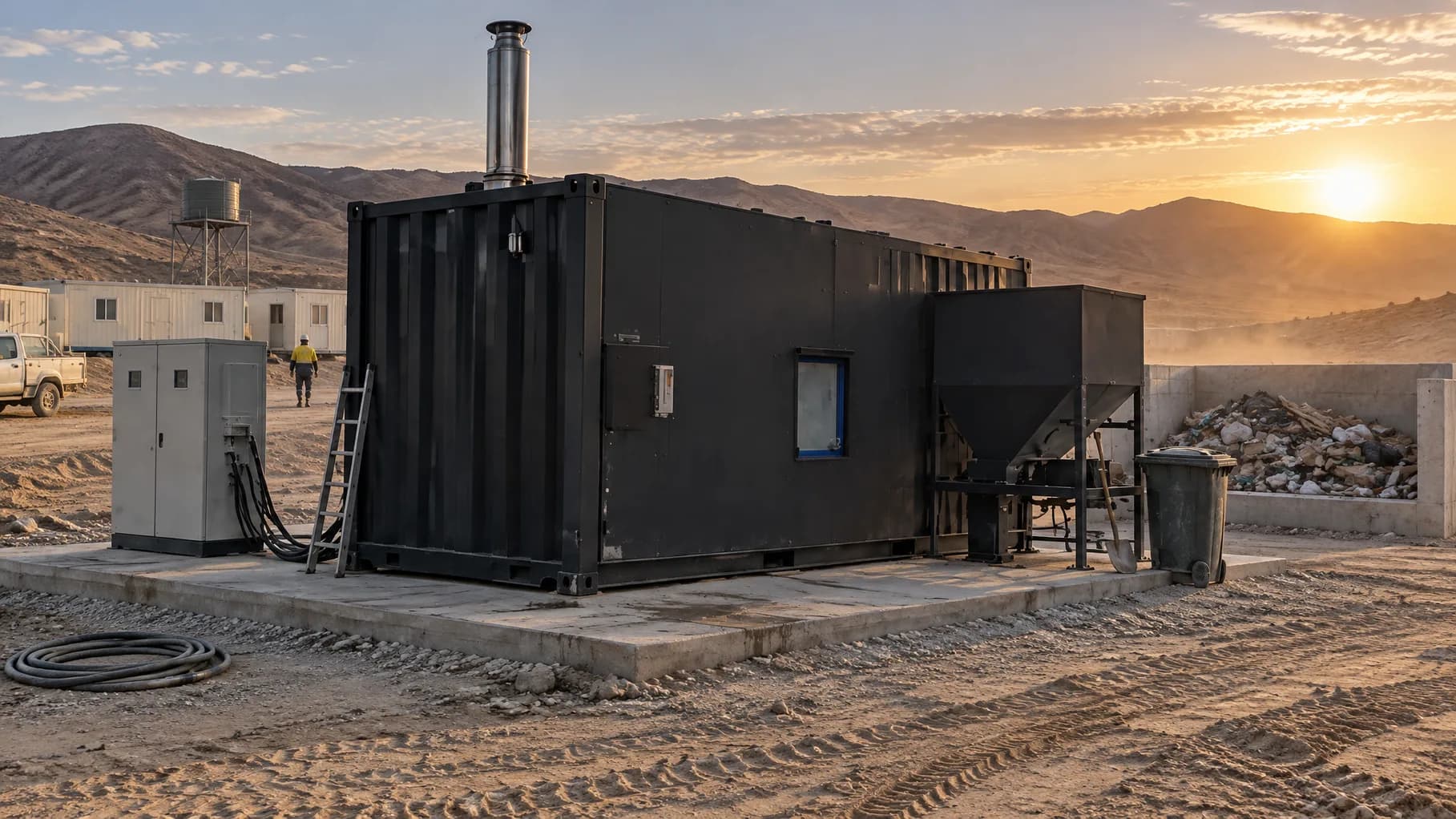
Solid waste is the supply line that never stops. The compact system closes it on site: waste goes in, electricity and heat come out, and what remains is an inert fraction near a tenth of the incoming volume.
- 01
RECEPTION AND SORTING
Waste received and sorted.
- 02
THERMAL CONVERSION
Controlled high-temperature burn.
- 03
ENERGY RECOVERY
Heat becomes power.
- 04
EMISSIONS CONTROL
Flue gas treated to standard.
- 05
INERT RESIDUE
About a tenth of the volume.
1 t/h1 t/h
WASTE THROUGHPUT
4,000 kWh4,000 kWh
ELECTRICITY PER DAY
16 t16 t
PER DAY AT 16 OPERATING HOURS
500 m500 m
OPEN BUFFER ZONE
02A LOCAL RESILIENCE HUB
One waste stream. Many services.
A compact unit near the waste, at a safe distance from homes, feeding the same microgrid that powers the site and reporting to the same remote screen.
ENVIRONMENT AND PUBLIC HEALTH
- Controlled treatment reduces waste volume and mass.
- Lower exposure to odors, pests, uncontrolled fires and contaminated land.
- Fewer long-distance collection trips.
LOCAL ENERGY AND RECOVERED HEAT
- Decentralized electricity for clinics, pumps, street lighting and communications.
- Hot water for showers, kitchens, laundries and medical facilities.
- Process steam for sanitation and institutional kitchens.
WATER, HYGIENE AND SANITATION
- Electricity for water pumping, filtration, desalination and wastewater treatment.
- Recovered heat for processes that need heated water.
- Heat and steam for sterilization.
OPERATIONAL AND ECONOMIC RESILIENCE
- Less dependence on diesel generators and central infrastructure.
- Lower transport fuel, vehicle demand and operating costs.
- Local jobs in collection, sorting, operation and maintenance.
Electrical and thermal outputs depend on waste composition and final supplier engineering.